
Philosophy
Abstract Romanticism.
A movement founded by Kamran Khavarani that restores feeling, beauty, and transcendence to contemporary painting.
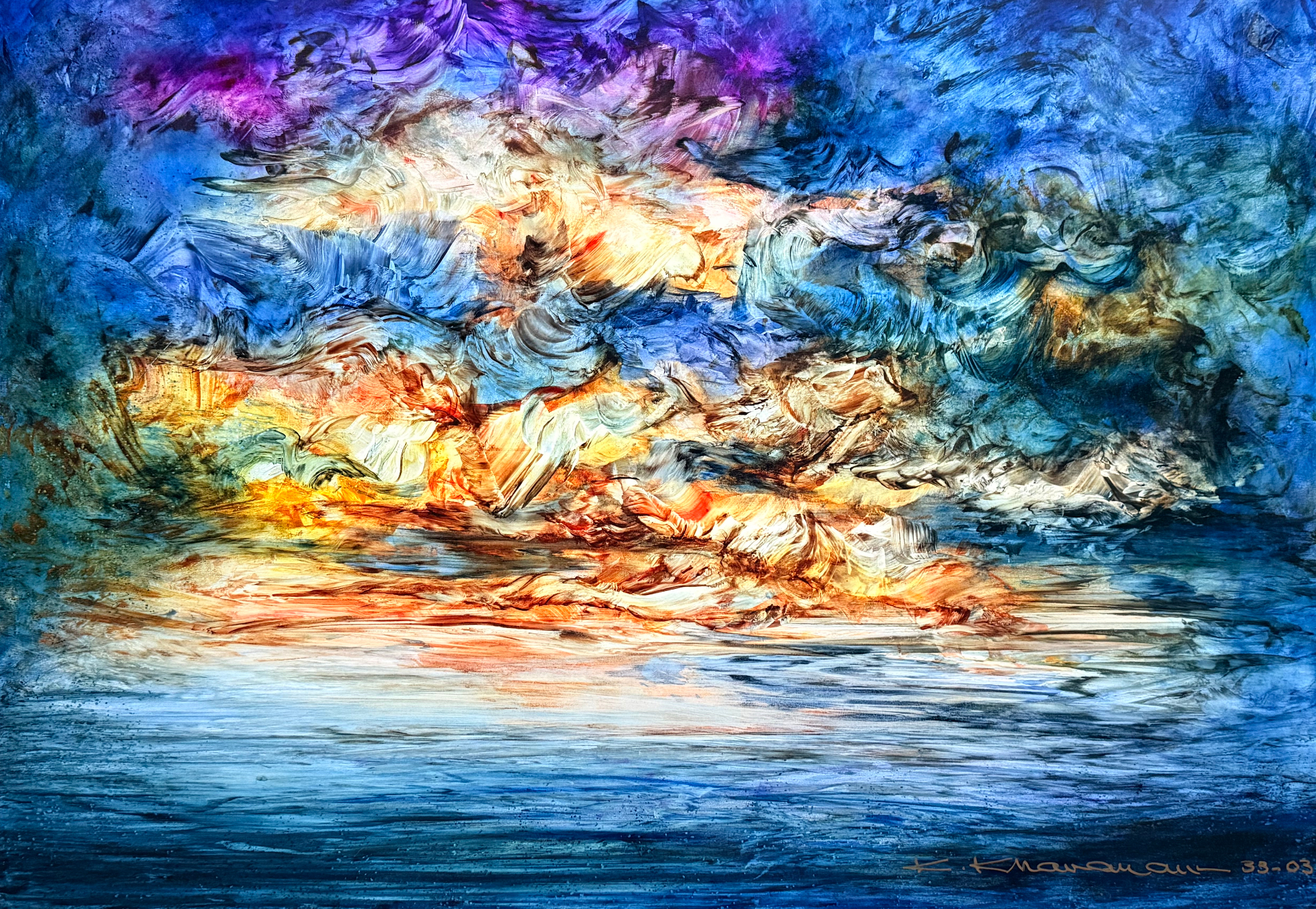
"The debut of a new art form, bringing emotion and beauty into the here and now."
Classically trained in painting from an early age, Khavarani’s artistic practice evolved from realism into a deeply personal visual language rooted in emotion, movement, and spiritual reflection. Inspired by the poetry and philosophy of Jalal ad-Din Rumi, his paintings explore themes of creation, transformation, memory, and the sublime. Flowers, trees, fire, water, wind, and earth appear throughout the work as recurring symbols of life’s constant movement.
Rather than depicting the visible world directly, Abstract Romanticism seeks to evoke an inner state. A sensation suspended between memory, silence, and light.
Khavarani often paints with his hands while wearing gloves, allowing gesture and physical movement to become part of the painting process itself. Layers of texture, light, and atmosphere emerge intuitively, giving the works a sense of motion and emotional depth.
The Four Principles
The Architecture of Feeling
I
Emotion Before Form
Painting begins with feeling. Technique exists to serve emotional truth rather than representation alone.
II
Light as Structure
Light is not an effect but the foundation of the composition. Carrying memory, movement, and revelation through color and atmosphere.
III
Gesture and Movement
The hand becomes part of the language of the paper. Motion, texture, and instinct guide the development of the work.
IV
Beauty and Transcendence
Abstract Romanticism embraces beauty not as decoration, but as a pathway toward contemplation, healing, and human connection.